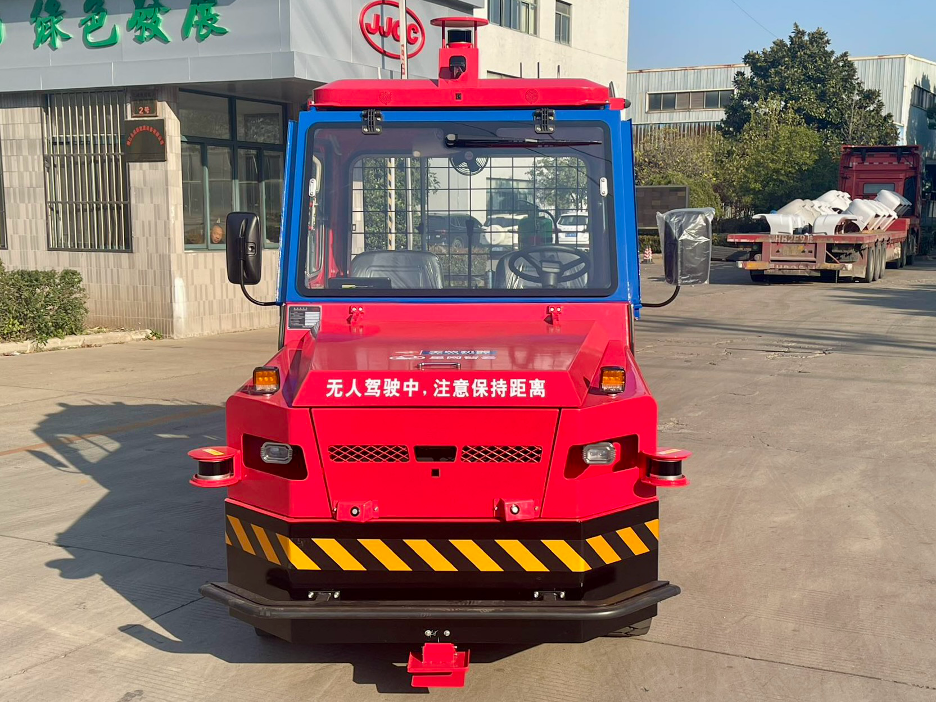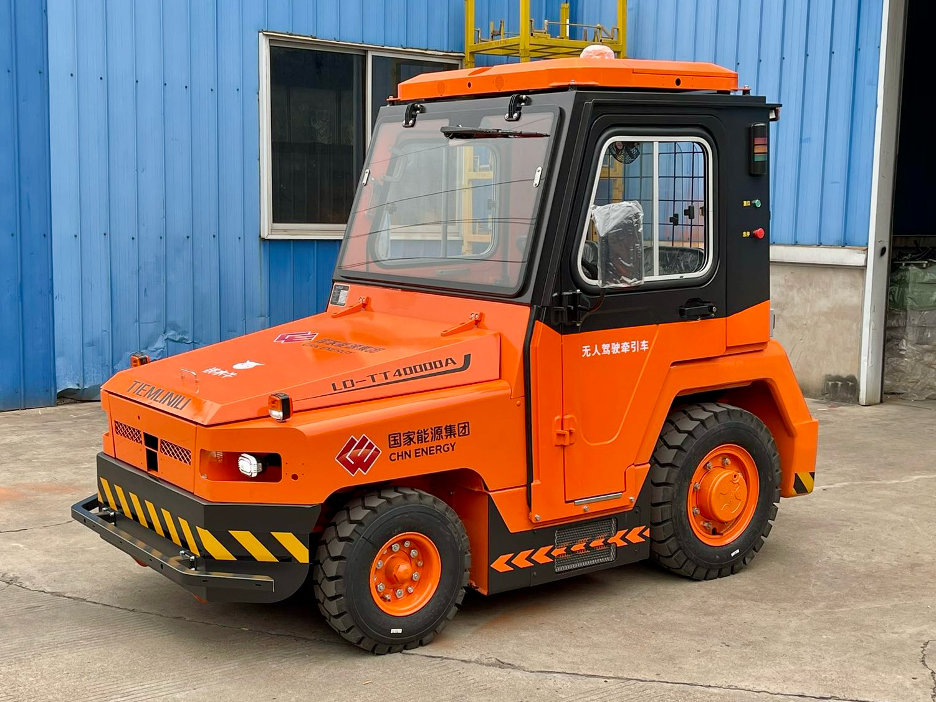
—- Jingjiang Forklift and Leador Information Technology Jointly Promote New Breakthroughs in Autonomous Tow Tractor Applications
In recent years, with the rapid advancement of artificial intelligence and autonomous driving technologies, driverless and smart solutions have become pivotal factors for the transformation and upgrading of the manufacturing and logistics industries. In 2022, Jingjiang Forklift (JJCC) and Leador Information Technology Co., Ltd. (Leador) established a strategic partnership, starting with the deep integration of vehicle chassis production and autonomous driving technology to jointly explore viable pathways for the commercial applications of autonomous vehicles. Over the past four years, continuous efforts from both parties have yielded remarkable achievements: more than 20 autonomous electric tow tractors have been successfully deployed, serving various sectors such as automotive manufacturing, Chinese state-owned enterprises, and machinery logistics.
This significant milestone not only demonstrates the power of technological innovation but also marks the transition of autonomous vehicles from the experimental phase to a new stage of large-scale application.
Technological Empowerment: Enabling Commercial Application of Autonomous Tow Tractors
Autonomous electric tow tractors combine electrification and automation at their core. Through multi-sensor fusion, precise positioning, and scenario adaptation, they achieve all-weather continuous operation, effectively reducing manual handling, improving onsite logistics efficiency, and lowering operational costs. Based on the analysis of mature industry products and case studies, the autonomous towing solution significantly enhances safety and operational continuity in settings such as industrial zones and airports, reducing delays and risks caused by human intervention.
As a professional vehicle chassis production base, JJCC leverages its profound expertise in manufacturing processes and product quality to provide stable and reliable hardware support for autonomous vehicles. Meanwhile, Leador’s technological capabilities in inertial navigation systems (INS), simultaneous localization and mapping (SLAM), vehicle-grade high-precision mapping, and digital twin platforms have supplied the core perception and positioning capabilities essential for this collaboration. This synergy ensures the stable operation of JJCC chassis and the integrated autonomous driving system in complex industrial and site environments. Public information from Leador indicates that the company possesses years of practical experience and application capabilities in multi-sensor fusion and digital twin simulation, underpinning the commercial deployment of autonomous vehicles.
This achievement goes beyond the supply of single units; it represents a systematic approach to promoting autonomous operations through the adoption of “chassis + software + service + scenario integration.” By combining vehicle hardware with Leador’s positioning, navigation, and scheduling platform, JJCC’s autonomous tow tractors have undergone trial operations and long-term tasks in diverse and challenging environments, including airport shuttle services, intralogistics, material transport in mining setting, and transfers of national strategic grain reserves. These applications validate the system’s feasibility in terms of durability, maintainability, and safety redundancy design. In line with industry trends, autonomous and AI-driven logistics innovations are becoming crucial forces for reducing costs and improving efficiency, offering a technological blueprint for the digital transformation of entire supply chains.
Multi-Industry Deployment Demonstrating Application Value
Since the collaboration began, autonomous electric tow tractors have been adopted across multiple industries and key clients, covering critical sectors such as automotive manufacturing, energy, and logistics vehicles. Specific deployment cases include:
- Automotive Manufacturing Industry: Industry leaders such as GAC Toyota and VOYAH Automobile were among the first to introduce this intelligent equipment. Autonomous tow tractors are used for material transport and production line replenishment within factory premises, effectively reducing labor costs while enhancing the accuracy and efficiency of logistics turnover.
- Chinese State-Owned Enterprise Sector: Enterprises including Guangxi Yuchai, China Energy Investment Corporation, GEM Co., Ltd., Sinograin, and Shendong Coal Group have adopted this technology. In scenarios demanding extreme safety standards and high efficiency, such as energy and grain reserves, autonomous vehicles have performed well, not only mitigating risks associated with manual operations but also setting a benchmark for the digital transformation of traditional industries.
- Machinery and Logistics Industry: Applications at Xi’an Xianyang International Airport and Hubei Ezhou Machinery have further expanded the scope of autonomous tow tractors. In airport logistics and large-scale machinery manufacturing, autonomous tow tractors achieve 24/7 continuous operation, significantly improving space utilization and operational automation levels.
These success stories fully demonstrate the maturity and practicality of autonomous tow tractor technology, providing a valuable reference for intelligent upgrades in more industries.
Autonomous and Intelligent: The Core Direction for Future Development
The collaboration between JJCC and Leador is not merely a resource-complementary partnership between enterprises but also an in-depth exploration of autonomous and intelligent innovation pathways. Through nearly four years of effort, both parties have accumulated extensive experience in technology research and development, product testing, and business model construction, laying a solid foundation for the further promotion of autonomous vehicles.
In the future, the two companies plan to deepen their cooperation by developing autonomous vehicle models adapted to more scenarios and accelerating the standardization and industrialization of the technology. At the same time, they will actively collaborate with government bodies and industry organizations to participate in the formulation and implementation of relevant policies, jointly building a more robust ecosystem for autonomous driving.
Conclusion
Driven by the dual engines of “chassis manufacturing + vehicle-grade perception + digital twin simulations,” the strategic collaboration between JJCC and Leador is a paradigm of close integration between traditional manufacturing and high-tech innovations. The application of over 20 autonomous electric tow tractors is not only a demonstration of technological achievement but also a powerful impetus toward a future vision of an unmanned and intelligent environment. Against the backdrop of increasingly intense global technological competition, such cooperation and innovation undoubtedly inject new momentum into the development of China’s smart manufacturing.
As more industries join the wave of intelligent transformation, the application prospects of autonomous driving technology will become even broader. JJCC and Leador will continue to leverage technology as their engine and innovation as their driver, contributing to China’s prominent position in the global autonomous driving landscape.